Category Academic English Courses

Academic Vocabulary for ESL Learners

Field-specific terminology across seven professional domains

This course is designed specifically for learners who need to transition to professional or academic contexts.

This course is not a traditional vocabulary list with definitions. It is a comprehensive, skills-integrated course to help you develop and use field-specific terminology with confidence.

What Will You Learn?

By the end of this course, you will be able to:

  • Recognize and produce word families without errors
  • Master collocations – words that naturally go together
  • Apply field-specific terminology for:
    • healthcare
    • business
    • Information Technology (IT)
    • engineering
    • legal services
    • architecture
    • social services

Skills Integration

  • Read and discuss 150-200 word academic texts
  • Listen to authentic workplace conversations
  • Speak in role-plays, meetings, and interviews
  • Write real-world documents: case notes, emails, reports

Course Content at a Glance

  1. What is Academic Vocabulary?
  2. Word Forms and Word Families
  3. Collocations and Natural Usage
  4. Strategies for Vocabulary Learning and Retention
  5. Terminology for the Healthcare Sector
  6. Business Sector Terminology
  7. Information Technology (IT) Field Terminology
  8. Engineering and Technical Fields Terminology
  9. Legal and Professional Services Terminology
  10. Terminology for Architecture and Construction Fields
  11. Terminology for Community and Social Services Fields
  12. Strategies for Self-Directed Learning

What Makes This Course Different?

  • Practical, not theoretical content: Using field-specific vocabulary with precision
  • Balanced skills: Reading, writing, listening, speaking, grammar, and vocabulary
  • Course Duration: 12 weeks (approximately 48–60 instructional hours)
  • Assessment: Pre-assessment, module-based tasks, and post-assessment
  • Format: Online, with weekly trainer-led sessions
  • Target CLB Level: 6-7

College Success for ESL Learners

Learn not just what to do at a Canadian college, but how to do it

Success in college is not just about English language proficiency – it prepares you to thrive academically, socially, financially, and professionally in the Canadian post-secondary system.

This course is uniquely designed for ESL learners who are actively navigating or about to enter Canadian post-secondary education. Ready to discover how Canadian higher education differs from what you experienced before?

What Will You Learn?

By the end of this course, you will be able to:

Demonstrate Academic Culture and Communication Skills

  • Interpret course syllabi accurately
  • Compose clear and professional emails
  • Collaborate effectively in group work
  • Develop a wellness plan with effective coping strategies
  • Reframe fixed mindset into growth-oriented perspectives

Develop Skills for Academic and Personal Success

  • Assess current knowledge and learning needs
  • Implement strategies to overcome learning obstacles
  • Apply methods for ongoing self-assessment
  • Participate in discussions using appropriate strategies

Course Content at a Glance

  1. Canadian College Culture and Expectations
  2. Building Relationships in College
  3. Mental Health and Well-Being
  4. The Right Mindset and Attitude
  5. Self-Awareness for Academic Success
  6. Goal Setting and Self-Regulation
  7. Learning Styles and Study Strategies
  8. Digital Literacy for Academic Success
  9. Financial Literacy in College
  10. Student Clubs and Networking
  11. Self-Directed Learning
  12. Preparing for Your Future Career

What Makes This Course Different?

  • Practical, not theoretical content: Developing language, and cultural skills for Canadian college
  • Balanced skills: Reading, writing, listening, speaking, grammar, and vocabulary
  • Course Duration: 12 weeks (approximately 48–60 instructional hours)
  • Assessment: Pre-assessment, module-based tasks, and post-assessment
  • Format: Online, with weekly trainer-led sessions
  • Target CLB Level: 6-7

Intercultural Communication for ESL Learners

Navigate the hidden rules of communication across cultures with confidence

Whether you are new to Canada or have been here for years, this course will give you the tools to turn cultural confusion into cultural competence.

You have been living or working in Canada and have experienced confusing or uncomfortable cross-cultural moments…

What Will You Learn?

By the end of this 12-module course, you will be able to:

Understand the Impact of Culture on Communication

  • Define culture and distinguish between visible and invisible cultural elements
  • Identify your own cultural patterns (individualism/collectivism, high-context/low-context)
  • Recognize stereotypes, implicit biases, and ethnocentrism in yourself and others
  • Practice cultural humility – the willingness to learn without assuming superiority

Adapt Your Communication Style to Different Cultural Contexts

  • Distinguish between direct and indirect communication across cultures
  • Recognize linear vs. circular reasoning patterns in speech and writing
  • Interpret silence, pauses, and nonverbal cues

Build Relationships and Transition to the Life in Canada

  • Build trust and rapport across cultural differences
  • Navigate intercultural friendships and relationships
  • Demonstrate intercultural competence

Course Content at a Glance

  1. The Role of Culture in Communication
  2. Identity and Cultural Perspectives
  3. Communication Styles Across Cultures
  4. Verbal and Nonverbal Communication Across Cultures
  5. Power, Politeness, and Communication
  6. Barriers to Intercultural Communication
  7. Language and Intercultural Relationships
  8. Intercultural Communication in the Workplace
  9. Transitioning to a New Culture
  10. Intercultural Friendship and Romance
  11. The Nature of Intercultural Conflict
  12. Why Intercultural Competence Matters in Canada

What Makes This Course Different?

  • Practical, not theoretical content: Develop intercultural awareness, empathy, and confidence
  • Balanced skills: Reading, writing, listening, speaking, grammar, and vocabulary
  • Course Duration: 12 weeks (approximately 48–60 instructional hours)
  • Assessment: Pre-assessment, module-based tasks, and post-assessment
  • Format: Online, with weekly trainer-led sessions
  • Target CLB Level: 6-7

    Study Skills for ESL Learners

    Unlock Your Learning Potential to the Fullest

    By the end of this course, you will not just be a better English learner – you will be a better learner in every area of your life.

    Ready to become a more effective, confident, and independent learner?

    What Will You Learn?

    By the end of this course, you will be able to:

    Use Proven Strategies for Better Learning

    • Identify your learning style and preferences
    • Apply 12 research-based principles to any learning task
    • Build daily habits using habit stacking and the chain method

    Boost Your Self-Efficacy and Motivation

    • Build confidence through mastery experiences
    • Develop a growth mindset and embrace challenges
    • Find your intrinsic “why” for learning anything

    Improve Your Academic Skills for Success

    • Use previewing, skimming, and scanning to read faster
    • Evaluate sources using the CRAAP test to perform better
    • Write clear paragraphs using the PEEL structure

    Course Content at a Glance

    1. Understanding How You Learn
    2. Memory and Retention Strategies
    3. The Twelve Principles of Memory
    4. Goal Setting Strategies
    5. Time Management and Organization
    6. Self-Efficacy and Motivation
    7. Reading and Note-Taking Strategies
    8. Critical Thinking and Deep Learning
    9. Test Taking and Stress Management
    10. Organizing Information and Essay Writing
    11. Metacognition and Self-Assessment
    12. The Growth Mindset and Lifelong Learning

    What Makes This Course Different?

    • Practical, not theoretical content: Developing study habits and trying new strategies
    • Balanced skills: Reading, writing, listening, speaking, grammar, and vocabulary
    • Course Duration: 12 weeks (approximately 48–60 instructional hours)
    • Assessment: Pre-assessment, module-based tasks, and post-assessment
    • Format: Online, with weekly trainer-led sessions
    • Target CLB Level: 6-7

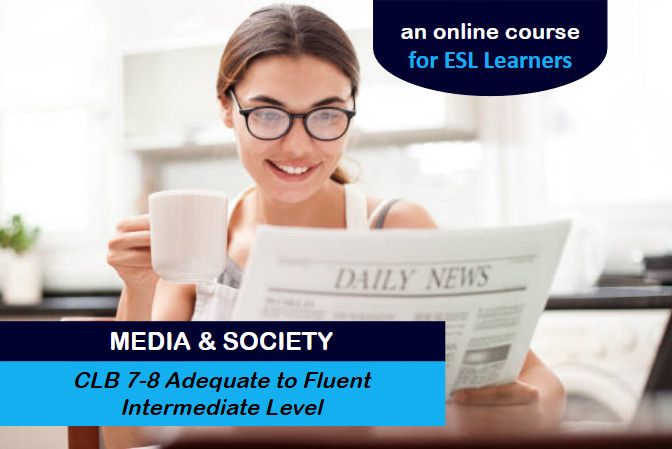
    Media & Society for ESL Learners

    Ready to Take Control of Your Media Life?

    This course will give you the tools, the knowledge, and the confidence to become a critical, mindful, and responsible media consumer.

    What Will You Learn?

    By the end of this course, you will be able to:

    Think Critically About Today’s Media-Driven Society

    • Ask the five essential questions every time you see a news headline, advertisement, or social media post.
    • Distinguish between misinformation (accidental falsehoods) and disinformation (deliberate lies).
    • Identify bias, framing, and manipulation techniques in news and advertising.

    Protect Yourself in Today’s Media-Driven Society

    • Recognize “dark patterns” — deceptive designs that trick you into sharing data or paying money.
    • Manage your emotional reactions to upsetting news and avoid doomscrolling.

    Understand How Media is Shaping Society

    • Explain how media acts as a “watchdog” that holds governments accountable.
    • Analyze how media representation affects marginalized communities.
    • Discuss the balance between national security and press freedom.

    Communicate Effectively in English

    • Write essays comparing how different news outlets cover the same event.
    • Participate in debates about media policy, privacy, and democracy.
    • Create a personal media consumption plan that supports your well-being.

    Course Content at a Glance

    1. The Changing Media Landscape
    2. The Role of Media in Society
    3. The Impact of Media on Individuals
    4. How Media Competes for Your Attention
    5. How Technology Is Reshaping Your Mind
    6. How News Media Shape Your Perception of Reality
    7. Why Media Is Essential for Democracy
    8. Media and Public Health
    9. How Media Reflects and Shapes Culture
    10. How Technology Invades Your Privacy
    11. Media Use and Well-Being
    12. Towards Mindful and Responsible Media Consumption

    What Makes This Course Different?

    Each module includes:

    • Vocabulary definitions and practice
    • Grammar explanations and exercises
    • Reading passages (150–250 words)
    • Listening audios with scripts (150–250 words)
    • Speaking activities (discussions, debates, role plays)
    • Writing tasks (paragraphs, essays, action plans)
    • Course Duration: 12 weeks (approximately 48–60 instructional hours)
    • Assessment: Pre-assessment, module-based tasks, and post-assessment
    • Format: Online, with weekly trainer-led sessions
    • Target CLB Level: 7–8

    Critical Thinking for ESL Learners

    Think Clearly. Question Wisely. Argue Fairly.

    This course helps you become a more analytical, confident, and independent thinker.

    This course focuses on practical strategies to help you succeed in your studies and career.

    What Will You Learn?

    By the end of this course, you will be able to:

    Develop the Right Mindset for Success

    • Distinguish between facts, opinions, and beliefs
    • Identify hidden assumptions and logical fallacies in arguments
    • Evaluate whether a source is credible using the CRAAP test

    Ask Powerful Questions

    • Recognize your own biases and practice intellectual humility
    • Build compelling arguments using evidence and clear reasoning
    • Disagree respectfully using the “steel man” technique

    Apply critical thinking to workplace, media, finance, health, and everyday situations.

    Course Content at a Glance

    1. Who is a Critical Thinker?
    2. Why Critical Thinking Matters
    3. Critical Thinking and Beliefs
    4. What is an Argument and Its Types?
    5. What is Evidence and Its Types?
    6. How to Identify Assumptions
    7. Focusing on Patterns of Reasoning
    8. Identifying Bias and Perspective
    9. Asking Critical Questions
    10. Clarifying and Probing for Understanding
    11. Evaluating Strengths and Weaknesses of Arguments
    12. Crafting a Compelling Argument

    What Makes This Course Different?

    • Practical, not theoretical content: Every skill applies to real life
    • Balanced skills: Reading, writing, listening, speaking, grammar, and vocabulary
    • Course Duration: 12 weeks (approximately 48–60 instructional hours)
    • Assessment: Pre-assessment, module-based tasks, and post-assessment
    • Format: Online, with weekly trainer-led sessions
    • Target CLB Level: 6-7